
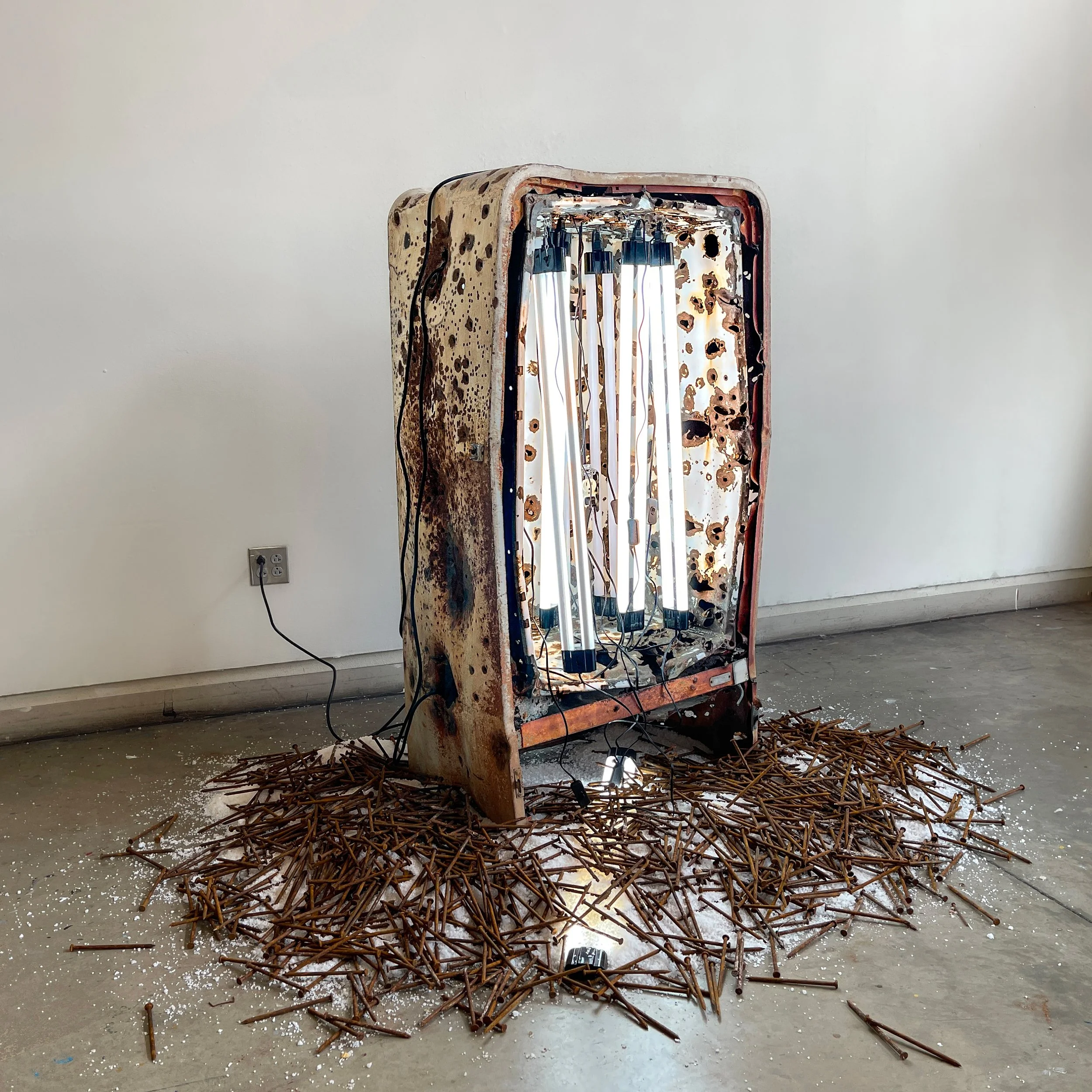
Queer Magnetism
Santa Fe Community Gallery | September 2025
Like a solar system, this exhibition of forty queer and transgender artists is a vast gravitational field. Each artwork is a metaphorical magnet, attracting some ideas and stories while repelling others. As LGBTQ+ creatives we draw together for celebration and activism, safety and survival, sex and romance. As a constellation of minority communities we reject bigotry and violence—in our own spheres and in the political arena.
QUEER MAGNETISM holds four “magnetic centers”—DIMENSIONAL, FIGURATIVE, BIOMORPHIC, and TEMPORAL—that explore contemporary queer and trans expressions. These passages open with historical artists who act as ushers into the present moment. The show honors the ways LGBTQ+ artists are inseparable from Northern New Mexico’s cultural fabric, beginning in Pueblo communities, which have long recognized fluid gender roles and non-heteronormative identities.
From these lineages, the exhibition spirals outward through regional 20th-century art colonies and counterculture movements, and into the flourishing artistic circles of the present. Defining one overarching approach or ethic is beside the point—our spectrum is too vast and polychromatic. But there are astonishing affinities throughout the exhibition that bridge time and space.
As you navigate the forces of QUEER MAGNETISM, consider your own magnetic powers—as a member of LGBTQ+ community or an ally.
– Carmen Selam & Jordan Eddy

DIMENSIONAL
Weavings are sculptures, sculptures are bodies.
Weaver and potter We’wha (ca. 1849-1896) works at her backstrap loom, a lithe artistic tool that relies on bodily tension. He was lhamana, a Zuni Two-Spirit person who assumes male and female pronouns, tasks, and ceremonial roles. In 1886, she traveled with other Zuni leaders to Washington, D.C., to meet President Grover Cleveland and advocate for his tribe.
Medicine man and weaver Hastíín Tłʼa (1867-1937) wears ceremonial garb—perhaps woven himself, as a practitioner of a traditionally female discipline. As a beloved Diné/Navajo leader, he tirelessly fought to uplift his religion and culture in the face of colonial efforts to impose Christianity. He was nádleehi, a Diné Two-Spirit person who innovated weaving traditions by incorporating symbolism from ceremonial sandpaintings.
These historical weavers embody fluidity—as tribal leaders and artists who traversed creative disciplines. The contemporary sculptors in the DIMENSIONAL passage of QUEER MAGNETISM similarly employ structural tension and material alchemy to create works that directly relate to—or abstractly reference—queer and trans bodies.
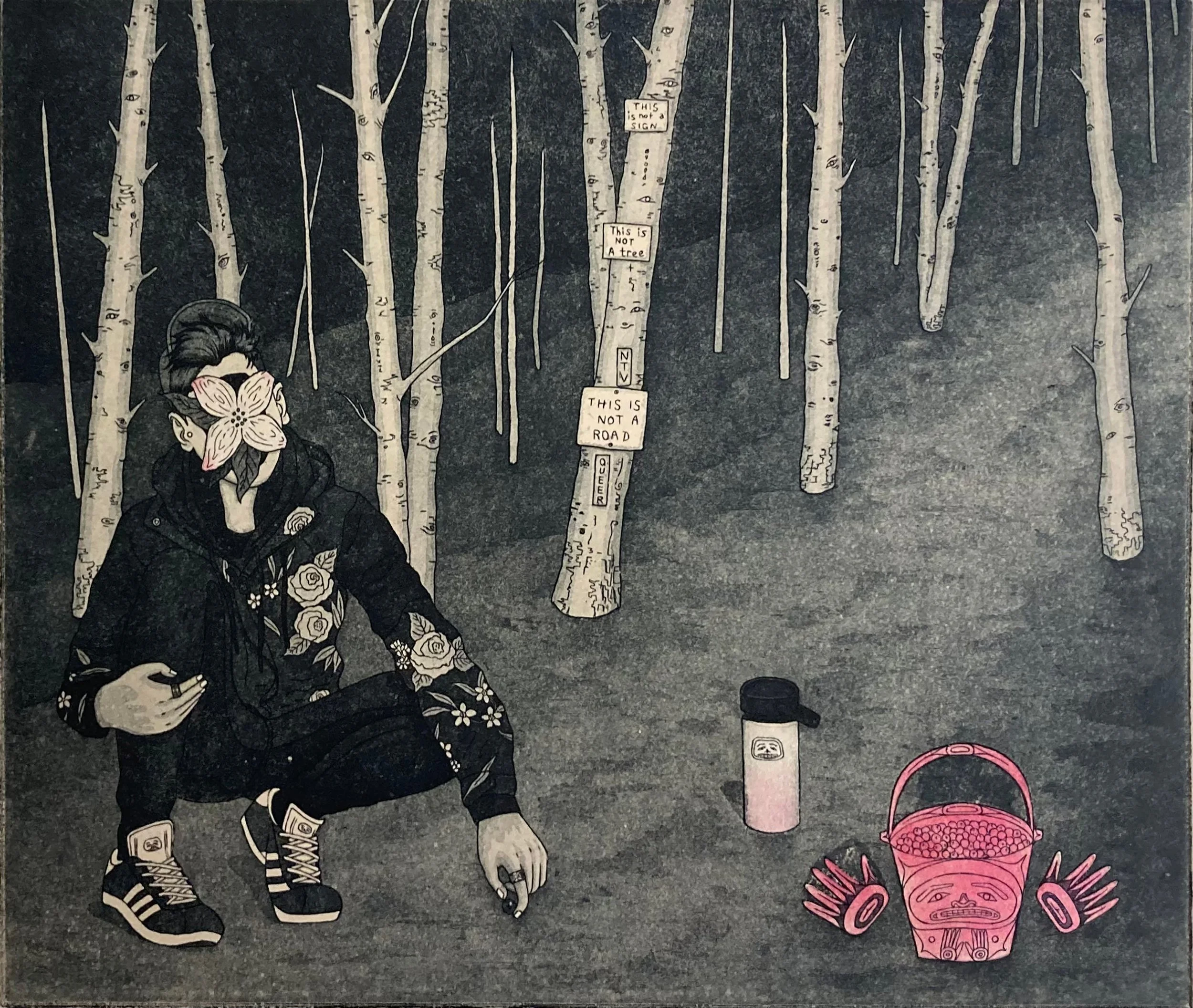
FIGURATIVE
A queer family tree is a scavenged thing.
Painter Max-Carlos Martinez (1961-2020) constantly invited other artists to his apartment and studio at El Zaguán, a 171-year-old complex on Canyon Road that hosts an artist residency. This charming habit bloomed into a salon series: exuberant parties featuring new artworks and literary writings. Born in Albuquerque, the gay artist invariably befriended his painting subjects—an artistic strategy and queer survival technique—as evidenced by Sally, a portrait of a Hopi woman wearing the squash blossom whorl hairstyle of an unmarried woman.
Martinez’s space became the living room of a chosen family, its salon-style cluster of color-blocked portraits mapping a web of influence and affection. In the FIGURATIVE zone of QUEER MAGNETISM, contemporary artists depict their loved ones and themselves, often obscuring or fragmenting queer and trans bodies to evoke intense emotional states, foster empathy, and offer tender protection.
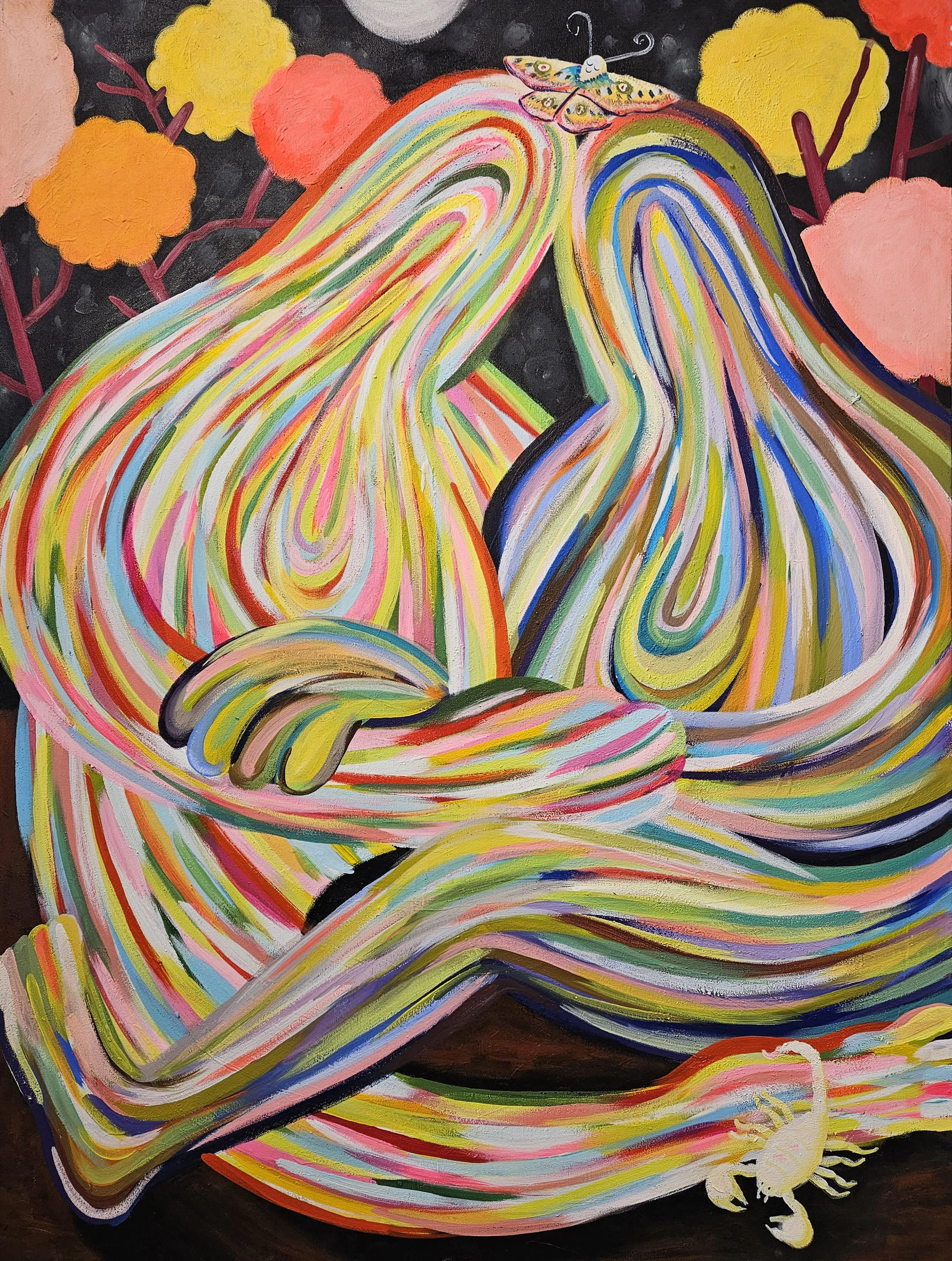
BIOMORPHIC
Humanity, and therefore art, is of nature.
Painter and printmaker Agnes Martin (1912-2004) did not directly reference nature in her abstract compositions—or so she emphatically stated many times. Still, her experiences of the wild clearly informed her artistic ethos: she wished for people to view her art “as you would cross an empty beach to look at the ocean.” Originally from Saskatchewan, Canada, the lesbian artist lived for nearly four decades in New Mexico, spending her final years in Taos.
Before she committed to grids and stripes, Martin engaged in what scholars labeled “biomorphic abstraction.” The bridge between this curvilinear early work and her straight-edged mature work (like the lithograph on display) may be shorter than it seems. “When I first made a grid I happened to be thinking of the innocence of trees,” Martin recalled.
The contemporary artists in the BIOMORPHIC zone of QUEER MAGNETISM can be just as oblique in their approaches to natural imagery—there are no horizon lines to be found. Instead, the artists offer subtle explorations of nature’s inherent queerness: in its infinite spectra, utter lack of binaries, and mercurial beauty.
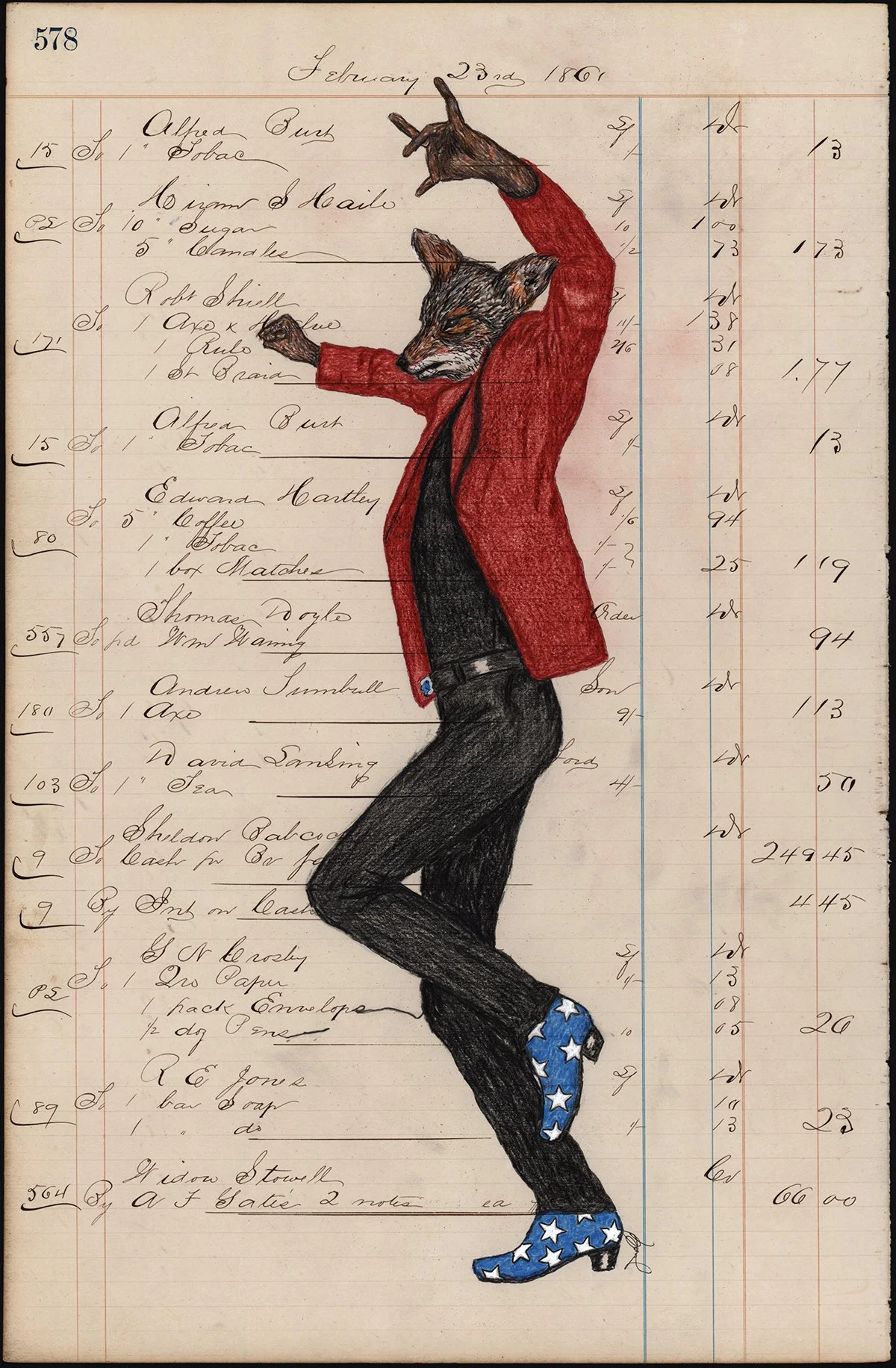
TEMPORAL
LGBTQ+ legacies are like mycelia—fruiting from the underground.
Artist and community organizer Tigre Mashaal-Lively (1985-2022) was a weaver of true mythologies. Perhaps their best-known tale was of the Solacii, a race of cosmic beings that linked across dimensions like a mycelial network, popping up to spread love wherever they were most needed. What seemed like fantasy was actually a group portrait of the queer and nonbinary artist’s intricately enmeshed community, who traveled the world building immersive art together.
Mashaal-Lively lived in Santa Fe for the last three years of their life, passing away at thirty-seven. In their drawing on display, an intersex Solacii tangles with a lion—a symbol of loyalty and strength. A monumental depiction of a Solacii also lived on Guadalupe Street for years, even after an unknown individual set it on fire. True to their calling, the artist’s friends gathered to restore it.
The mythopoetic arc of Mashaal-Lively’s projects—from intimate DIY settings to global stages including the Burning Man festival—echoes that of many queer legacies. The contemporary artists in the TEMPORAL passage of QUEER MAGNETISM secretly cultivate love and rage, connecting hidden histories with grand legends—and then unleashing it all on an unwitting world.
ARTISTS
(Historical artists in bold)
Julia Arriola (Mescalero Apache/Mayo), Drew Austin, Betsy Bauer, Kari Bell, Asa Benson-Core, Jennifer Billig, Amanda Curreri, Austin Eichelberger, Pascal Emmer, Apolo Gomez, Haley Greenfeather English (Turtle Mountain Band of Chippewa Indians/European/Irish), Andrew Michael Joseph, Hastíín Tl’a (Diné), Jami Porter Lara, Ethan Lauesen (Denaakk’e Koyukon Athabaskan, Ahtna Athabaskan, Tlingit), Patti Levey, Oriana Lee, dylan lilla, c marquez, Agnes Martin, Max-Carlos Martinez, Tigre Mashaal-Lively, Nate Massé, Izzy Mondragón (Chickasaw, Purepecha, Xicanx), Ocelotl Mora, Moss, Hilary Nelson, Bazille Owen-Reese (Ho-Chunk Nation), Louie Perea, Selena Quiros, Emily Rankin, Hugo Ximello Salido, Carmen Selam (Yakama Nation), Kimberly Sewell, Polina Smutko, Lauren Snyder, Robbie Sugg, Victor Teng, J. Matthew Thomas, Matthew Valiquette, We'wha (Zuni Pueblo)
Press
“Bringing together 40 artists, historical and contemporary, whose work spans disparate styles and media is no easy task. For such an exhibition to actually say something meaningful about queer art in New Mexico without a dissertation’s worth of text panels is even tougher. Yet it succeeds.”
—Logan Royce Beitmen, Albuquerque Journal
My contributions: Curatorial with Carmen Selam. Exhibition design with Rebecca Aubin.
Artwork: Polina Smutko (featured and top image), Amanda Curreri, Ethan Lauesen, Julia Arriola.
Special Thanks: Chelsey Johnson, Santa Fe Arts and Culture Department.